The Place Setting Is Not a Seating Chart
A place setting can signal welcome, ceremony or convenience. Learn how to read its arrangement without mistaking table order for social rank.
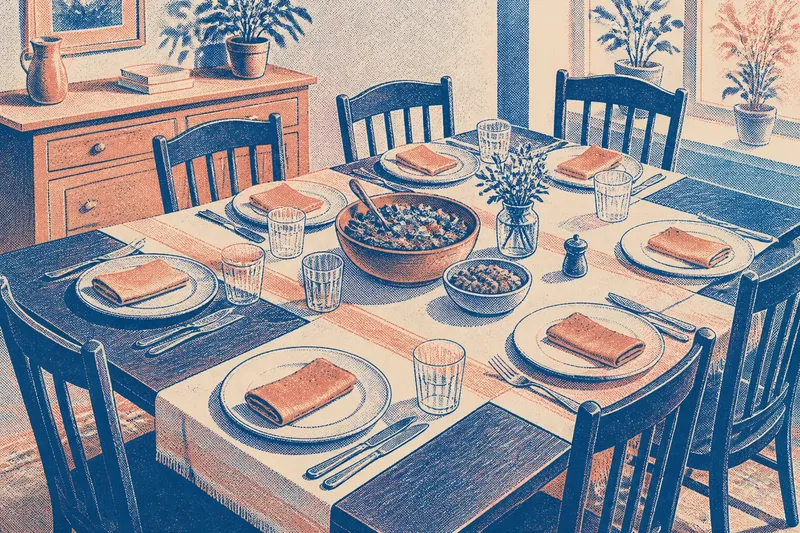
A folded napkin waits beside a plate, while the chairs around the table remain unclaimed. That place setting may look like a seating chart, but it does not necessarily assign anyone a rank or a particular seat. A place setting can organise a meal, mark an occasion or make a guest feel expected; its meaning depends on the people using it and the moment they are sharing.
To read a table thoughtfully, look beyond its symmetry. Notice who placed the objects, what the gathering calls for and whether anyone explains the arrangement. These clues help distinguish a practical layout from a social instruction without assuming that one familiar style speaks for every household or community.
Does a place setting tell you where to sit?
Sometimes, but not by itself. A name card, an explicit invitation to a particular chair or a host guiding guests to places makes the arrangement clearer; a plate, glass and cutlery laid at each seat may simply prepare the table for whoever sits there.
Even a carefully matched setting can be made for ease. A host might set each place in advance so that guests can arrive at different times, or so that serving dishes have room in the middle. Order on the table can reduce uncertainty about where a fork belongs while leaving the choice of seat open.
Context matters because a table is both a working surface and a social space. In one gathering, a seat near the host may be chosen to help an older relative hear the conversation. In another, the same position may be reserved for a guest of honour. The objects alone cannot settle which interpretation applies.
How can you tell whether the arrangement is ceremonial?
Look for cues that single out a moment or a role: a distinctive cloth, a serving piece brought out for a particular meal, a place marked for a person who is absent, or a repeated arrangement used at a family or community observance. Such details may indicate that the table carries meaning beyond the mechanics of eating.
But ceremony is not always elaborate. A familiar arrangement can acquire significance through repetition: people may know which dish belongs at the centre or which place is kept clear for a customary act. Conversely, a polished table may be only the host’s preferred way of preparing for guests. Ornament is not proof of a formal code.
When the occasion is unfamiliar, observe before rearranging anything. If a setting seems to have a special purpose, a quiet question to the host is usually more respectful than moving it or announcing what it must mean. Ask in practical terms: “Would you like me to sit here?” That lets the host clarify without requiring you to guess at the history of the custom.
Why do place settings differ between households?
Households inherit and adapt ways of arranging food around their own rooms, routines and relationships. The number of dishes served, the use of shared platters, the shape of the table and the number of people expected all affect where objects go. A layout that works for a formal dining room may be awkward at a small kitchen table.
Customs also change as people move, marry, share homes or cook together across generations. A household may keep a familiar way of placing bowls while changing the cutlery, or adopt a serving habit from a friend without treating it as a fixed tradition. Such choices can hold affection and practicality at once.
That variation is a reason to avoid treating one style as the universal standard. The position of a spoon, glass or bread plate may be conventional in one setting and unnecessary in another. If a host’s arrangement differs from what you learned, it may reflect the meal’s needs rather than a mistake or a coded statement about status.
What does the table arrangement do for a guest?
A place setting can make arrival easier. A clean plate and ready glass tell guests that there is room for them, while a clear path to shared dishes can help them understand how the meal will be served. These are forms of hospitality expressed through objects, not necessarily declarations about who matters most.
Arrangement can also protect the flow of a meal. A host may leave space for a serving platter, keep hot dishes away from a narrow edge or put water within reach of several people. In those cases, convenience is not the opposite of welcome; it is one way welcome is made workable.
Imagine a host preparing a table for relatives who will arrive at different times. She sets out plates and glasses at each chair but leaves the chairs unassigned, placing a serving bowl where everyone can reach it. The expected result is a table ready for the meal without implying that a particular person has been allocated a particular seat.
How should you respond to an unfamiliar place setting?
Start with the host’s spoken directions and the actions of others. If people choose their own seats, follow their lead; if someone points you to a place, take it as an instruction for this gathering rather than assuming it reveals a permanent social hierarchy.
For an unfamiliar arrangement of cutlery or dishes, wait until the meal begins and watch how the host serves. You can also ask where a shared dish should go or whether a plate is intended for serving. A small, direct question is often more useful than trying to decode every object as a symbol.
- Check whether a name card or a spoken instruction identifies a seat.
- Notice whether shared dishes are meant to be passed or served by the host.
- Look for objects that seem reserved for a specific part of the meal.
- Follow the host’s cues before moving a setting or taking a chair.
- Ask discreetly when an arrangement affects what you should do.
These observations help you participate without imposing an interpretation. They also leave room for the host to explain a custom in their own terms, rather than asking them to confirm a broad assumption about their background.
Can the same setting mean welcome and convenience?
Yes. A table can be orderly because the host wants guests to feel expected and because a prepared layout makes serving easier. Those purposes do not conflict. The same plate may carry a practical function and contribute to a sense of care.
This overlap is why a place setting is a poor substitute for a seating chart unless people make it one. A table offers clues about how a meal might proceed, but its social meaning emerges through use: who is invited, how the host guides the gathering and what participants understand together. When those signals are uncertain, asking is better than assigning meaning from the arrangement alone.
Next time you see a place setting, treat it first as an invitation to notice, not a verdict about rank. Read the table in company with the people around it, and you are more likely to recognise whether its order is there to honour a moment, welcome a guest or simply make dinner easier to share.