A Bowl for Serving or a Bowl for Keeping
A serving bowl or keepsake bowl is shaped by what people ask it to do: follow its handling, display and memories to read its role more clearly.
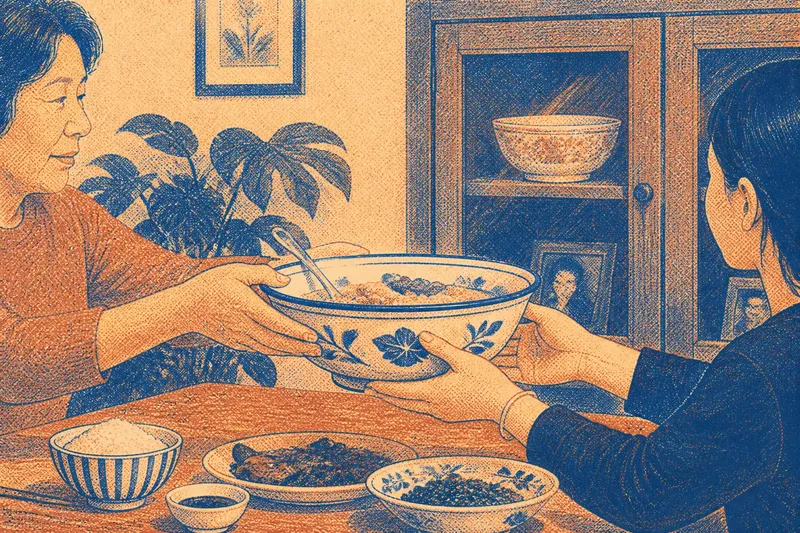
At a family table, a wide ceramic bowl passes from one pair of hands to another, while a smaller bowl in the cabinet stays behind glass. The serving bowl or keepsake bowl distinction is not always visible in the material: both may be glazed, painted or inherited. Their difference emerges in the work people assign them, and in the ways that work shapes handling, display and memory.
A bowl’s role begins with what happens around it
A serving bowl has a place in a sequence. Someone fills it, carries it, sets it down, and expects others to reach for it. Its usefulness depends partly on being available: easy to lift, positioned within reach, and suited to holding something that will be shared. The bowl may also gather meanings through repetition, but its immediate task is public and practical.
A keepsake bowl is more often held apart from ordinary use. It may occupy a shelf, cupboard or display case, where looking matters more than reaching. Its value can lie in a remembered giver, a family occasion, a place of origin or the fact that it has remained in the household. These meanings are not built into the object alone; they are sustained by the people who tell its story and decide how it should be treated.
The categories can overlap. A bowl used to serve a particular dish at annual gatherings may become an object of memory precisely because it has served so often. Another may be brought out only for guests, combining ceremonial use with careful preservation. Instead of asking what a bowl “really is”, notice what it is permitted to do.
Handling leaves a visible social record
Use has a physical vocabulary. A serving bowl may have a broad rim for gripping, a foot that steadies it on a table, or a shape that makes it easier to pass. Its surface can carry the small signs of contact: utensil marks, softened edges, a worn patch where hands repeatedly hold it. Those traces do not automatically make it less valued. They may show that it has been included in household life.
A kept bowl often receives a different kind of attention. Someone may lift it only to dust the shelf, wrap it before a move, or bring it out to show a visitor. That limited handling can express care, but it can also make the object harder to know through touch. The bowl’s status is then communicated by distance: where it sits, who may move it, and whether it is treated as fragile or ordinary.
These patterns are social, not universal rules. In some households, valuable objects are used so their quality can be appreciated; in others, frequent handling would seem careless. Even within one family, a bowl may pass between roles as circumstances and owners change.
Display turns a household object into a sign
Placement affects how a bowl is read. On a dining table, it belongs to a shared activity. In an open cabinet, it may be visible but protected; on a high shelf, it can read as a prized possession or as an object with no everyday task. A display arrangement can make material, decoration and age easier to notice, while separating the bowl from the bodily gestures that once gave it practical meaning.
Look for the company a bowl keeps. Is it grouped with usable dishes, positioned beside photographs, or displayed alone? Does it appear in a kitchen, where serving is plausible, or in a room arranged for guests? The surrounding objects and the household’s habits offer clues, but neither proves a single interpretation. A bowl can be displayed because it is beautiful, because it is difficult to replace, or because its owner wants a particular memory close at hand.
Say you inherit a painted bowl that an older relative used for fruit. You put it on a living-room shelf because its decoration matters to you, then occasionally return it to the kitchen for a family meal. Its role has not simply changed from “useful” to “precious”: the shelf makes its appearance prominent, while the occasional meal renews its connection to the person who used it. Someone else in the family might remember the same bowl differently.
Memory gathers around use, absence and ownership
Memory does not require a bowl to remain untouched. A serving bowl can hold a story through familiar occasions: who carried it, what was placed inside, and which people gathered around it. Its meaning may come from repeated actions that no longer happen. When the household changes, an object that once moved freely between kitchen and table can become a keepsake because it now carries the trace of a vanished routine.
Conversely, an object preserved for display may have a history of use that is no longer visible. A bowl inherited from a relative might have served guests, held offerings, or marked a family event before it entered a cabinet. Asking about its earlier life can reveal more than its appearance does. If no one knows, that uncertainty is part of its present history rather than a gap that needs to be filled with a guess.
Ownership also shapes memory. A bowl may be associated with the person who chose it, the person who cared for it, or the person who now decides where it belongs. These connections can differ. One relative may treasure its painted surface; another may value the meals it recalls. A careful description can hold both meanings without insisting that one is the authentic one.
What questions help you read a bowl’s role?
How can I tell whether a bowl is meant for serving?
Notice its position, ease of access and signs of repeated contact, then consider whether people actually bring it to the table. Shape and wear can suggest use, but household practice gives those clues context.
Does a keepsake bowl have to stay unused?
No. Some families preserve an object by limiting its use, while others honour it by bringing it into meaningful gatherings. The owner’s reasons and the bowl’s condition help explain the choice.
What should I ask when I inherit a bowl?
Ask who used it, where it was kept, and whether any occasion or person is linked to it. If accounts differ or are incomplete, keep those versions distinct rather than turning a family recollection into certainty.
Can one bowl be both practical and commemorative?
Yes. A bowl may serve food and also recall the people who gathered around it. Its practical role and remembered associations can reinforce one another without cancelling each other out.
Read the object without forcing a single meaning
When considering a serving bowl or keepsake bowl, attend to three things together: the gestures it invites, the place it occupies, and the stories attached to it. A bowl’s rim or glaze may offer clues, but handling and display show how those qualities matter in a particular home. The most useful account leaves room for change: an object may move from table to shelf, or return from shelf to table, while carrying traces of both lives.
If you are documenting a bowl, note its materials and visible condition separately from what people remember about it. That simple distinction lets later readers see where observation ends and family interpretation begins. It also keeps the object open to new meanings, without losing the particulars that made someone keep it.